
Light Your Night provides professional Christmas light installation for residential and commercial properties across Pennsylvania, covering design, commercial grade lighting, installation, in season service, takedown, and storage. Most homeowners searching for professional Christmas light installation are not really asking what it is. They are asking whether it is worth it, having spent somewhere between five and twenty Decembers doing it themselves.
So here is the honest version, including a whole section further down explaining when doing it yourself is the better call. A comparison written by a company that sells one side of it is only useful if it is willing to argue the other.
Table of Contents
What does professional Christmas light installation do that a homeowner on a ladder cannot?
Professional installation differs from DIY in six practical ways: lights are cut and built to the measurements of the specific house rather than assembled from fixed length retail strands, commercial grade product is rated for repeated seasonal outdoor use, bulb spacing and alignment stay consistent across the entire facade, height and pitch a homeowner cannot safely reach get covered, mature trees are wrapped properly rather than draped, and a failure in mid December becomes a phone call rather than another trip up the ladder.
1. Lights built to the house, not to the strand
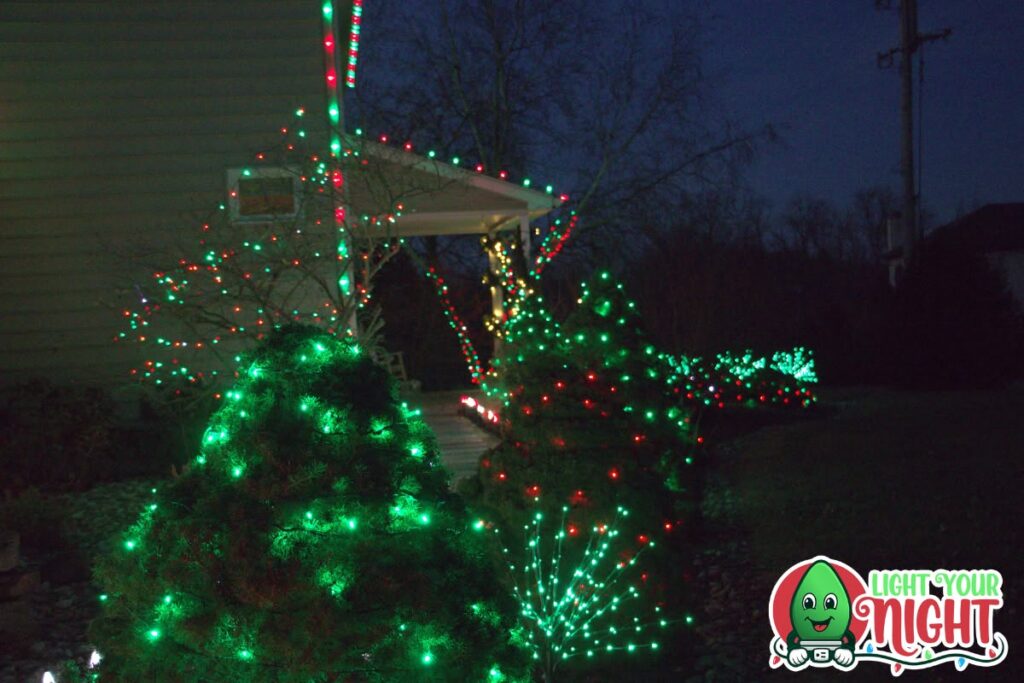
This is the difference almost nobody considers, and it explains why professional displays read differently from across the street. Retail strands come in fixed lengths. A DIY run either falls short of a roofline or overshoots and doubles back on itself. Professional installers measure each section and cut runs to length, so every line terminates exactly where the architecture does.
That is the whole reason one house looks deliberate and the next looks approximately right.
2. Commercial grade product
Briefly, since what a professional installation includes is covered in more depth elsewhere on the site. The point here is durability. Commercial grade strands are built for repeated seasonal outdoor cycling. Retail consumer sets are built to hit a price point on a shelf in October, and they perform accordingly by their third or fourth season.
3. Consistent spacing across the whole house
On a ladder you work one arm span at a time and you cannot see the elevation you are working on. Spacing drifts. Lines sag unevenly between attachment points. The result looks fine from six feet away and noticeably uneven from the kerb, which is the only place anyone actually looks at it from.
Professionals work to a consistent spacing standard and check alignment from the ground as they go. This is the single largest visual difference between the two approaches.
4. Height and pitch you should not be attempting
Stated once, plainly, and then we move on. Second and third story rooflines and the steep pitches common in Pennsylvania housing built for snow load require fall protection and equipment most households do not own. The Consumer Product Safety Commission publishes emergency department data on holiday decorating injuries each year, and falls from ladders are consistently the largest category. That is context, not a sales argument.
5. Trees wrapped, not draped
A genuinely visible skill gap. Wrapping a mature tree well means consistent spiral spacing up the trunk and out along the major limbs, which takes practice, careful ladder work, and considerably more light than people expect when they first try it. Most DIY tree lighting is a strand thrown over the lower branches. Homeowners tell us this is the element they knew they could not replicate.
6. Mid season failure becomes someone else’s problem
When a section fails on a cold evening in December, the DIY homeowner either gets the ladder out again or lives with a dark stretch until January. That is the entire difference, and anyone who has done it knows exactly which of those two they usually choose.
Do professional Christmas lights actually look different from store bought ones?
Yes, and in four specific ways. Uniform bulb spacing across every run. Matched color temperature, which matters more than people realise, because retail sets from different production batches vary noticeably in tone and the mismatch is obvious once the sun goes down. Runs that terminate at architectural lines rather than mid wall. And no visible extension cord routing. The color temperature point is the one nobody knows about, and it is why a display can be hung perfectly well and still look subtly wrong.
When is doing it yourself genuinely the better choice?
Doing your own lights makes sense when the display is limited to a single story roofline or ground level features you can reach safely, when the scope is modest enough to finish in an afternoon, when you genuinely enjoy the process, or when the budget is better spent elsewhere this year. A small ranch with a front gutter line and a wrapped shrub does not need a professional crew, and any company telling you otherwise is selling rather than advising.
Single story, reachable, modest scope
A front gutter line on a ranch. A wrapped porch column. A few shrubs along the walk. All reachable from a step ladder on level ground, all finishable in an afternoon. That is a perfectly good DIY project and there is no sensible reason to pay someone for it.
You actually enjoy it
Some people do. A Saturday in November, a coffee, the radio on, and a result they take some pride in. If that is you, the calculation is genuinely different, and we would rather say so than pretend enjoyment is an obstacle to be overcome.
The budget is better used elsewhere this year
Some years a household has other priorities and the lights are the thing that flexes. That is a completely reasonable decision, and a company worth calling is one that will still be worth calling in the year those priorities change.
Where the line usually sits
Generally, the second story. Once any part of the display requires an extension ladder against a two story elevation, three things increase at once: the time it takes, the risk you are carrying, and the gap between what you can achieve and what a crew can. That is a threshold rather than a rule, but it is where most homeowners find the answer changes. For residential displays below that threshold, keep your ladder.
What does the real cost comparison look like once you count everything?
Comparing professional installation against doing it yourself means counting more than the quote. A DIY display carries replacement strands each season as sets fail, storage space and the reality that stored consumer lights degrade, several hours to install and several more for takedown across two of the coldest months of the year, and a ladder risk that appears on no receipt anywhere. The professional quote is one visible number. The DIY cost is several smaller invisible ones spread across the calendar.
The costs that do not appear on a receipt
Replacement strands, every season or two, as retail sets fail one string at a time. Storage space in a garage or attic, which is not free in any practical sense once you account for what else could live there. Time: realistically an afternoon or a full weekend day to install, plus a cold morning in January to take it all down. And the ladder, which most homeowners stopped enjoying several years before they were willing to say so out loud.
The value that is genuinely hard to price
Two things. The result itself, which for most homes is visibly different in the ways described above. And, more relevant for most people, the disappearance of the entire project from the calendar. Two winter weekends returned to you. That is the actual purchase, and it is worth naming plainly rather than dressing it up as holiday magic.
Working out your own answer
If your display is single story and you enjoy the afternoon, keep doing it. If any part of it needs a two story ladder, if you have replaced strands three years running, or if the January takedown has become the part you quietly dread from about the 27th of December onward, get a quote and compare it against the full list above rather than against zero.
How much does professional Christmas light installation cost compared to doing it yourself?
Professional quotes are built from linear footage, roof height, and scope, which means the range across different homes is wide enough that any published average would mislead more than it helps. A two story colonial with multiple peaks and three wrapped trees is a different project from a ranch with a front gutter line. The useful comparison is not the quote against nothing, it is the quote against your own annual total: replacement strands, storage, and two weekend days. Request a property specific quote and run that arithmetic with a real number in front of you. For commercial properties the question does not really arise, since insurance and liability requirements make professional installation the only workable route.
Two Winter Weekends Back. That Is the Real Product.
Some houses genuinely do not need this, and you now have the framework to tell whether yours is one of them. Single story, reachable, and you like doing it? Keep the ladder. Anything above that, and the comparison is closer than the quote alone makes it look.
Request a quote from Light Your Night and compare a real number against your own list.