
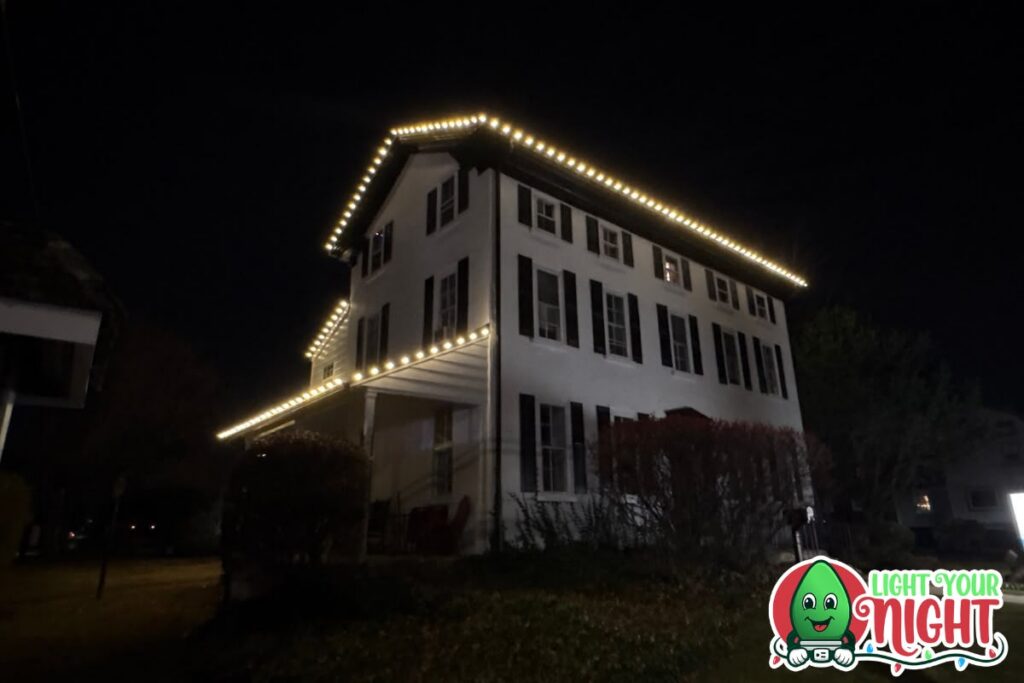
Light Your Night installs permanent holiday lighting across Pennsylvania for residential and commercial properties. It is a system of fixed, app controlled LED fixtures mounted discreetly under the soffit line that stay on the house year round and are effectively invisible during daylight. Permanent Christmas lights answer a question seasonal installation never can, which is what happens in year two, year five, and year ten, because the system goes up once and then simply gets switched on.
You have probably driven past one without knowing it. A house lit in a color that was clearly not a string of C9 bulbs. A neighbour who goes orange in October and red and green in December without anyone ever appearing on a ladder in between.
This article covers what the system actually is, the honest cost comparison across ten years rather than one season, and a straight account of who it does not suit. A page that only argues one side is not worth your time.
In this article:
- What is permanent holiday lighting, and how is it different from seasonal Christmas lights?
- Does permanent lighting cost less than seasonal installation over time?
- Who is permanent lighting right for, and who should stick with seasonal?
What is permanent holiday lighting, and how is it different from seasonal Christmas lights?
Permanent holiday lighting is a fixed track of individually addressable LED fixtures installed under the soffit or along the roofline, wired to a controller and operated from a phone app. Unlike seasonal Christmas lights, installed in November and removed in January, a permanent system stays on the house year round, sits flush against the trim so it reads as part of the architecture during daylight, and can produce any color or pattern on demand rather than the single fixed color of a traditional bulb strand.
It disappears during the day
This is the objection everyone has first, so let us deal with it first. The track is color matched to your trim and sits tight under the soffit edge. From the street in daylight, it reads as a trim line. Most people who have rejected the idea of permanent lighting have pictured bulbs visible on the house in July, and that is simply not what these systems look like.
It is not only for Christmas
This is the part that changes the whole calculation, and it is why the name of the category is slightly misleading.
Orange for Halloween. Red, white and blue for the Fourth of July. School or team colors on game day. Soft warm white as everyday accent and security lighting for the rest of the year, which is what most owners end up using it for more than anything else.
A system used ten months a year is a fundamentally different purchase from one used for six weeks. Hold onto that, because the arithmetic in the next section depends on it.
Control is from your phone, and it is genuinely simple
Scheduling, brightness, color, preset patterns. You set it once for a holiday and forget about it. It is convenient rather than clever, and that is the right way to think about it.
LEDs last a long time
This is what makes the ten year comparison meaningful rather than theoretical. The US Department of Energy publishes guidance on LED lifespan and efficiency, and rated life for quality LED fixtures is measured in tens of thousands of hours. These systems are specified in decades, not seasons.
Can you see permanent Christmas lights on the house during the day?
Honestly? From the street, no. The track is color matched to the trim and tucked under the soffit edge, and it reads as a trim detail rather than as lighting. Standing at the house, close up, you can see the channel.
We would rather tell you that than claim it is completely invisible, because you can walk up to any house with a system installed and check for yourself. The accurate description is discreet, not invisible, and for the overwhelming majority of homeowners discreet is what they actually wanted.
Does permanent lighting cost less than seasonal installation over time?
Permanent holiday lighting costs substantially more upfront than a single season of professional installation, and substantially less across a ten year horizon. Seasonal installation is a recurring annual cost. Permanent lighting is a one time install followed by electricity. The comparison that matters is not this December against this December. It is ten consecutive seasonal installations, each with its own install, takedown, and storage, against one permanent system that also runs for Halloween, the Fourth of July, and every ordinary evening in between.
What seasonal installation actually costs across ten years
Every year: design, installation, in season service, takedown, storage. Every year, again. Ten times.
Plus the annual scheduling. Plus the booking window that closes in November whether you were ready or not. Plus the fact that the price rises with labour costs across a decade, so year ten does not cost what year one did.
Take the last seasonal quote you received and multiply it by ten. Hold that number for a moment.
What permanent lighting costs across the same ten years
One installation. Then electricity, which on modern LED systems is genuinely minor.
No annual install. No takedown. No storage. No booking window to miss because October got away from you.
The usage multiplier that changes the arithmetic
Seasonal lighting gets used roughly six weeks a year. A permanent system gets used for every holiday plus everyday accent and security lighting, realistically around ten months.
Comparing cost per season understates it substantially. Compare cost per year of actual use and the answer moves considerably.
Where the break even usually sits
It depends on the size of your display and the seasonal price you are comparing against, but it typically lands somewhere in the mid single digit years.
Which reduces the whole question to something much simpler than arithmetic: do you plan to be in this house long enough to pass that point?
How much do permanent Christmas lights cost?
Permanent lighting is quoted per linear foot of track installed. The cost drivers are total footage, roof height and access, the number of controllers the system requires, and whether any electrical work is needed to supply it.
The important structural difference from seasonal: it is a single quote, not a recurring annual price. That is the number you compare against ten years of the alternative, not against one. Request a property specific quote and we will measure and give you a real figure to run against your own seasonal history.
Who is permanent lighting right for, and who should stick with seasonal?
Permanent holiday lighting suits homeowners who intend to stay in the property roughly five years or more, who already pay for seasonal installation annually, who want lighting for more than one holiday, or who want everyday architectural and security lighting alongside the seasonal use. Seasonal installation remains the better choice for anyone planning to move within a few years, renting, wanting the specific traditional look of warm white C9 bulbs, or working to a budget where the upfront cost is not practical this year.
When permanent is clearly the right call
A long term home, especially one already paying for seasonal installation every year, where the arithmetic above has already inverted and you just had not calculated it.
Tall or steep rooflines, where annual installation is expensive precisely because access is difficult. Those homes benefit most, because the recurring cost being eliminated is a high one.
Homeowners who want more than December. Most people land here once they realise the system does Halloween, the Fourth of July, and everyday accent lighting.
New construction or a re-roof in progress. If the track goes in during the work, there is no retrofit consideration at all. If you are building or re-roofing, this is genuinely the moment to decide.
When seasonal installation is the better choice
If you are moving within a few years, the arithmetic never inverts and the value does not transfer cleanly to the sale.
If you rent, a permanent fixture is not your call to make.
If you want the traditional warm white C9 look, particularly on a period or historic home, a color changing LED system is a different aesthetic and it will not satisfy you. That is a real preference and we are not going to talk anyone out of it.
And if the upfront cost is not practical this year, seasonal installation is a perfectly good answer. We would rather say that plainly than push someone into a payment they resent every month.
The question that actually decides it
How long do you intend to live here?
Almost everything else follows from that. A reader who can answer it honestly does not need any more persuading in either direction.
Does permanent lighting affect your home resale value?
It is a fixture, so it stays with the house, and buyer reactions vary. Some see a desirable feature already installed and professionally done. Others are indifferent to it.
What we will not claim is that it increases your sale price, because that is not something anyone can substantiate. What is fair to say is that a discreet, color matched, professionally installed system is far more likely to be read as an asset than a visible retrofit job. Commercial properties are a different calculation again, since year round architectural lighting carries operational and branding value beyond any holiday.
One Install. Then Never Again.
Everything comes back to the one question. How long are you staying?
If the answer is a few more years, seasonal installation is the right call and we are happy to keep doing it. If the answer is a decade or more, you are almost certainly already past the break even point and have been paying the recurring version of a one time cost.
Request a permanent lighting quote from Light Your Night and we will measure the property and give you both numbers so you can compare them properly.