
Table of Contents
Retail centers and downtown business districts have leaned hard into holiday displays over the past couple of years, and it is not just for decoration. A well done storefront display pulls people out of their cars and onto the sidewalk, and property managers across Pennsylvania have started treating commercial Christmas lights as a real line item worth budgeting for, not an afterthought.
This guide walks through the types of commercial displays businesses actually use, how installation at this scale differs from a typical residential job, and what the process looks like once you decide to move forward.
What Types of Commercial Christmas Lights Do Businesses Actually Use
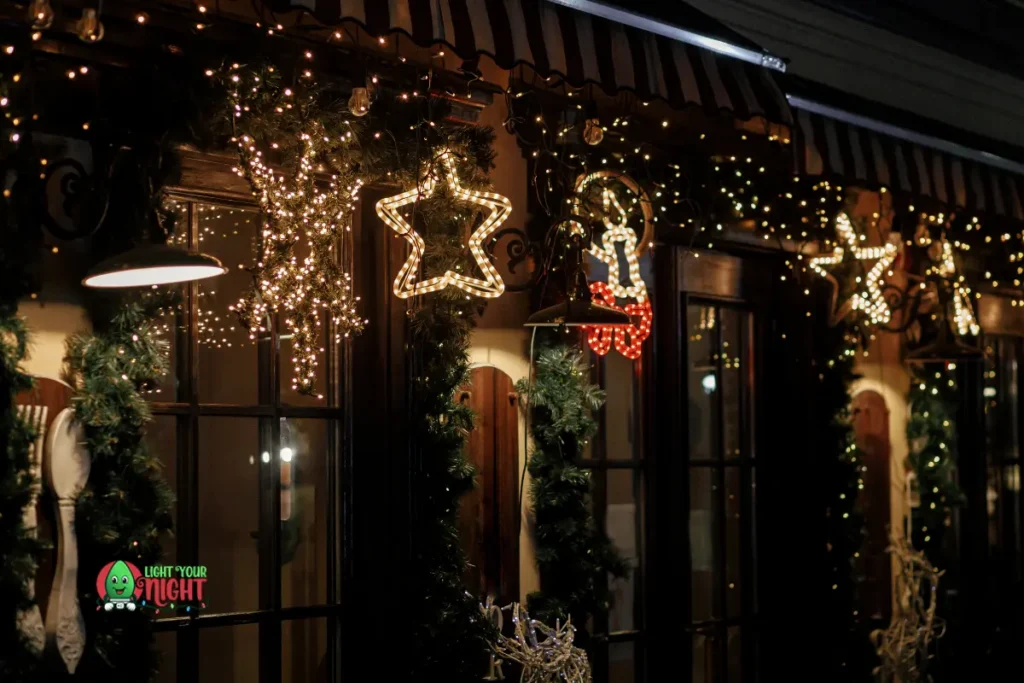
Most commercial requests fall into a handful of categories, and figuring out which one fits your property is the first real step. Storefront and building perimeter lighting is the most common starting point, outlining the front of a building or a row of storefronts so the property reads as lit and inviting from the street. Tree and landscape lighting comes next, often used across shared property at a retail center or office campus to tie multiple buildings together into one cohesive look.
Custom branded displays are where things get more specific. Some businesses want their actual brand colors worked into the lighting itself, so the display doubles as a subtle marketing touch rather than a generic holiday look. And for larger properties, coordinated displays across multiple buildings are their own category entirely, since keeping five storefronts or an entire campus visually consistent takes more planning than a single structure ever would.
If what you are picturing sounds more like a single large private home than a shared commercial property, residential Christmas lighting is likely the better fit and a different pricing structure applies there.
How Is Commercial Christmas Lights Installation Different From Residential
This is really a scale and coordination question more than anything else. A residential job is one roofline, one homeowner making the decisions, and usually a straightforward install. Commercial work often involves multiple structures, sometimes multiple tenants who all need to sign off on the same look, and safety or code requirements that are typically stricter for public facing property than for a private home.
Pricing follows a different logic too. Instead of one number tied to a single roofline, commercial quotes tend to scale with total square footage and the complexity of coordinating across a property. That is worth understanding going in, since comparing a commercial quote directly against a residential number rarely tells you anything useful.
For a sense of how Light Your Night approaches pricing generally, our Pennsylvania installation cost guide breaks down the residential side of that structure and gives a good baseline for how transparent, property specific pricing works here. And for a broader national reference point, national data on Christmas light installation cost gives a general sense of what installation runs across the country, though commercial scope and square footage move that number more than almost anything else.
What Does a Commercial Christmas Lights Installation Actually Look Like in Practice
Picture a small retail center with five storefronts that wants one cohesive display tying the whole property together instead of five mismatched setups. The process usually starts with a site walk through, where the specific buildings, shared landscaping, and any brand considerations get mapped out into an actual design proposal.
Installation gets scheduled around business hours, so a coffee shop or boutique does not have crews working in front of customers during a busy afternoon. Once the season wraps up, takedown happens on a set schedule too, so the property manager is not the one tracking down a crew in January or wondering when the lights are finally coming down.
If you want more detail before looping in a property owner or management company, visit our full holiday lighting blog for additional planning resources and examples of past commercial work.