
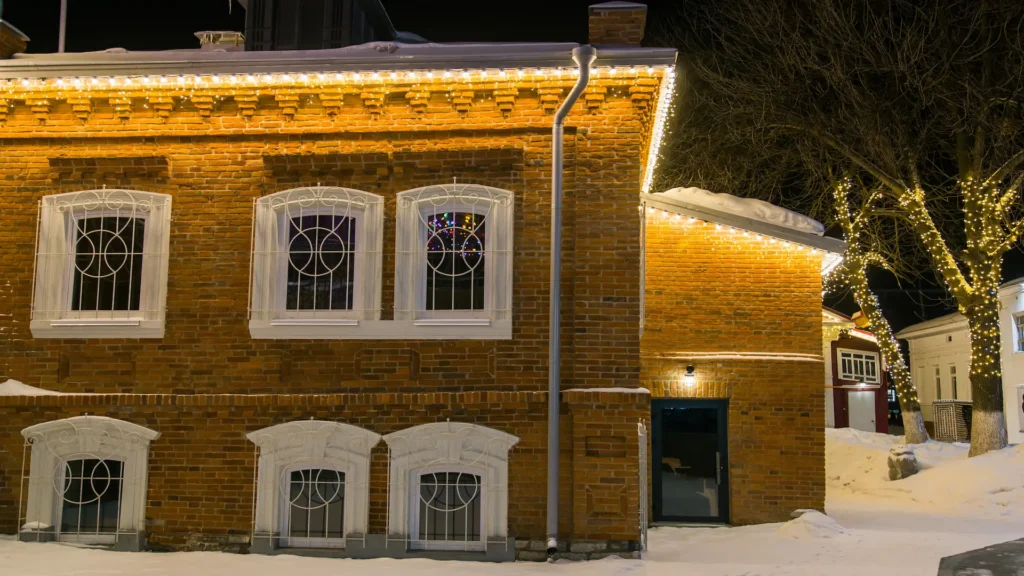
Light Your Night installs commercial Christmas lighting for businesses across Pennsylvania, including retail storefronts, restaurants, hotels, office parks, and HOA common areas. A commercial display is not a residential job made bigger. It runs on a different schedule, carries insurance and access requirements a house never does, and gets judged on whether it brings people through the door rather than on whether the owner enjoys looking at it.
In December your frontage is competing with every other lit frontage on the block. The ones that look considered get noticed. The ones that look improvised read as effort rather than investment, which is worse than doing nothing.
If you are treating this as a marketing spend rather than decoration, that framing is correct. Here is what it actually involves.
Table of Contents
What does a commercial Christmas lighting project actually involve?
A commercial project typically covers building rooflines and architectural features, entrance and canopy lighting, wrapped trees and landscape features across the property, and interior window or lobby display where relevant. Unlike residential work, it also involves scheduling around business hours and public access, liability insurance for a commercial property, coordination with landlords or property management, and in season service response fast enough that a failed section does not sit dark through a peak trading week.
1. Installation happens around your customers
A residential crew works an empty driveway. A commercial crew works around parking, deliveries, foot traffic, and trading hours. That usually means early mornings, evenings, or a phased install across several days rather than one continuous block.
Ask any contractor how they intend to work around your operating hours before you book. If they have not thought about it, you will find out on the first morning.
2. Insurance is sized differently
A policy adequate for residential work is not automatically adequate for a commercial property with public access. If a member of the public is injured near a work area, the coverage question is materially different from a homeowner’s driveway.
Request the certificate and confirm the limits match the property. The OSHA guidance on working at height is worth a look if you want to understand what a properly run commercial install should look like on site.
3. Landlord and property management approval
If you lease, you usually cannot simply commission exterior work. Attachment methods, any electrical supply, and sometimes the design itself may need sign-off.
Raise this first, not last. It is the single most common reason a commercial project misses its date, and it is entirely avoidable.
4. The display has to be consistent across the property
A house can be lit approximately and still look fine. A commercial frontage cannot. Inconsistent spacing or mismatched color temperature across a long elevation reads as carelessness, and customers attribute that to the business rather than to the installer.
This is where professional installation matters more commercially than it does residentially.
5. Failure has a cost
A dark section on a house is an annoyance. A dark section on a storefront during the second week of December is a trading week spent with a worse frontage than the business next door.
Get the in season response commitment in the agreement, not in conversation.
Can a business set up a synchronised or animated light show?
Yes, and it is worth understanding how that actually works. A true music-timed or animated display needs addressable fixtures, a controller, and power planning, which means it is built on permanent lighting systems rather than seasonal strands. The control infrastructure has to stay in place to be worth installing.
That makes it a different project from a seasonal install, with a higher upfront cost and no annual reinstall. For businesses wanting a genuine show rather than a static display, permanent is generally the route, and it also gives you Halloween, the Fourth of July, and brand colors the rest of the year.
When do Pennsylvania businesses need to book, and why is it earlier than residential?
Book between June and August, earlier than residential customers, because commercial displays typically need to be live by mid November for the shopping season rather than late November. Installation also takes longer, requires scheduling around trading hours, and may need landlord or property management approval before work can begin. A business enquiring in October is usually too late for that year.
Your deadline is Black Friday, not Christmas
This is the framing that matters most for retail. A homeowner wants lights for Christmas. A business wants them working for the start of the shopping season, which is several weeks earlier. That one difference moves the entire timeline forward.
Approval takes longer than installation
Landlord sign-off, property management review, and in some cases board approval can run weeks. That process happens before scheduling, not alongside it. Business owners consistently underestimate this, and it is the most common reason a project slips.
Installation is phased, not single-day
Larger properties are installed across several days, often outside trading hours. That needs a scheduling block rather than a slot, and blocks get allocated early.
Year two is easier
Commercial clients typically renew annually, and the measurements and often the lighting itself are reused. Year two is faster and smoother than year one, which is worth knowing if you are justifying the first-year cost to an owner or a board.
The full booking calendar covers residential timing if you want the comparison.
What should you have ready before requesting a commercial quote?
Have five things ready: the property address and which elevations or features are in scope, your required live date, your trading hours and any windows when installation is not possible, confirmation of who approves exterior work if you lease, and any brand color requirements. Having these at the first conversation typically shortens the quoting process by a week or more.
Scope. Which elevations, entrances, trees, and features. A rough list is enough to start. The site visit refines it.
Your live date. Not Christmas. The date the display needs to be working, which for most retail is mid November.
Access windows. Trading hours, delivery times, and any period when work is impossible. This shapes the schedule more than the size of the job does.
Who approves. If leased, confirm early whether landlord or management sign-off is needed and who holds it. Biggest schedule risk on the list.
Brand requirements. Some businesses need specific colors for consistency. Flag it upfront, because it affects product selection and lead time.
Is commercial Christmas lighting a marketing expense?
Many businesses treat seasonal display as marketing rather than maintenance, on the reasoning that it drives footfall and brand impression during the highest revenue weeks of the year. How it should be categorised in your books is a question for your accountant, not for us. But if you are building the case internally, the footfall argument is the one that usually lands.
Your Frontage Has One December to Work With
The date that matters is when the display goes live, not when Christmas arrives, and approval is almost always the long pole in the schedule rather than installation.
Request a commercial quote from Light Your Night and we will walk the property, work around your trading hours, and give you a scope you can take to whoever needs to approve it.